PCO/PCOP/PCUY
Wagons.
In the early 1980’s, after
approximately twenty years after the introduction of overseas containers,
things started to change. The height of containers was increasing as well as
the weight they could carry. The new standard maximum weight for ISO containers
was 24 tonnes.
The main stay of the QR wagon
container fleet was the QFC wagons which was limited to carrying 42 t of
general freight. The wagons could carry two 20 t containers, the wagons did not
have a centre container mounting position, if required to carry one container
it was loaded on one end, (the hand brake
end). Due to the load not being between the bogies, the container was
limited to 19 t. Being a dual purpose wagon fitted with a timber deck (floor 1030 mm above rail) also placed limitations
on the container height being carried. The growing height of containers was
also forced infrastructure changes to the network, bridges, tunnels, platform
awnings etc.
QR had number of single
slot wagons capable of carrying one 24 t container, but most were for
specialised/specific traffic. One container per wagon makes a long train with a
small pay load. Other recent wagons entering service were designed around a freight
forwarder requirements using odd size domestic containers.
To meet the changing
scene in container traffic on the current track standard of 15.75 t per axle (“A” Class Lines), a new wagon was
developed. Between April and August 1986
Commonwealth Engineering, Salisbury delivered 100 new PCO wagons (45250 –
45349).

Wallangarra (Meat Export Traffic from the New England area of NSW)
QR drawing P 405. The
wagon was 14 500 mm over coupler, 13 440 mm over headstock, and when loaded the
floor was 930 mm above the rail. Their tare weight was 14.2 t allowing for a
pay load of 48.8 t on “A” class lines, two by 24.4 t containers. QR 38A bogies (3.26
t) with 760 mm wheels were fitted to the wagon. The wagons were express freight
wagons (red circle) with a maximum speed of 80 km/h. These wagons were fitted
with buffers, the buffer head was larger diameter than most freight wagons. The
wagons could carry one or two 20’ foot (6.1m) or one 40 foot (12.2 m) container.
Containers should as far a possible be loaded with their end doors inwards. If
the wagon was loaded with one 20’ container, the weight was restricted to 19 t.
and should be carried on the hand brake end. They could also carry 1 x 7.6 m container,
SCR fridge containers. Again there is no centre mounting position for a 20’ container.
At times if required to carry one 20’ container at maximum weight a ballast
container (half height container with flood rock) was added to the other end.

QR 38 Bogie
In 1989, 100 wagons (# 45616 – 45715) and between January and May 1990, another
60 wagons (# 45728 – 45787) were delivered by ANI Ruwolt Ipswich as the PCOP
class. As the
classification suggested with a “P” on the end of the classification, these
wagons were available for passenger trains, a white 100 was displayed in the
red diamond. QR 50B bogies being fitted to the wagons. QR drawing P 405 A shows the same details as the
PCO wagon. Photos suggest the floor was more open than the previous PCO wagons
and some minor construction changes were made. The wagons were fitted with
dummy buffers to protect brake pipe cocks/hoses in a changing drawgear environment.


Between February and April 1991 the company delivered
another 50 wagons (45792 – 45841). Fifteen wagons were delivered as PCOP wagons
with QR 51 bogies, the rest were PCOY wagons fitted with QR 50 A bogies. The
requirements to keep the PCOP wagons available for passenger train operations
if required may of been a tall order, ultrasonic wheel testing ever three
months would of created a huge amount of shunting to cut out wagons for the
wagon maintenance depots and a large amount of down time for the wagons. It
didn’t take long for all PCOP wagons to be reclassified to PCOY wagons, “Y”
being the code for 100 km/h wagons.

Rocklea.
In 1992, 10 wagons were
allocated to BP bitumen traffic, the wagons were fitted with two 20’ bitumen
tank containers and recoded PCBY wagons. (45812, 45818, 45829, 45837, 45735, 45761,
45776, 45684, 45694, 45701). The wagons were loaded at Bulwer Island (Pinkenba),
conveyed on shunt trains to Acacia Ridge/Clapham/Normanby to be added into
trains for their destination.

Bundaberg
The wagons pathed the way
for 100 km/h freight services on the North Coast Line (NCL). The first test
train was CU19 on the 19th July 1992, the train was hauled by a 3900
class EL conveyed 36 containers of nitropril and cover wagons from Clapham to
Moranbah, about 1,200 t.. Instruction indicated that PCOY wagons were to be
used for the train. The train departed Clapham at 6:00 pm, Normanby 6:32 / 7:00
pm (change locos), Maryborough West 12:30/40 (change crews), Rockhampton arr.
7:23 am.
The wagons formed part of
the NCL 100km/h project in 1995, all (PCO/PCOY) wagons were modified to the
required standard where necessary and reclassed PCUY. The “U” code had the same
meaning as the “O” code (15.75 t axle load) and was used to show change within
the class without adding another letter.
With the introduction of
PCZY wagons for the NCL to accommodate longer containers (46’/48’), in 1998, 67
wagons were allocated to the Mackay sugar traffic replacing the 93 PYCM wagons which
entered service in 1967. The wagons were fitted with readers and classed PCUM. These
wagons were fitted with two QRST bulk sugar containers and conveyed bulk sugar
from Sarina, Marina and Proserpine to the Mackay Harbour. 2017 was the last use
of these wagons, Proserpine being the last mill to use rail in the area. Outside
the sugar season (January – June), the wagons could be returned to general
traffic.


In the late 1990’s some
oil companies move tank wagons from interstate to Queensland, most had the tank
removed and mounted onto a container frame. These tank containers were conveyed
on PCUY wagons mainly on the Mt Isa line. Around 2000, BHP loaded steel rod/bar
into QR half height 20’ containers, there was a good chance that PCUY’s were
used for this traffic.


On platform wagons I like
to build my own coupler pockets. I’m not a fan of gluing coupling boxes to wagons
floors, they have a habit of letting go at times. Often there is very little
material for a screw. Building my own allows me to reduce the yoke and reduce
the sideway movement/swing in the coupler shaft. Wide opening in couple boxes
allow the couple to move to one side when pushing back increasing the chance of
pushing the wagon off the track on curves. The size of the yoke will be subject
to the radius of your curves. Kadee have a narrow coupling box #262 which I use
regularly were when I can screw it to the floor. An added bonus is that they fit
between the 12 mm wheels. You may need to play around with packing to get the
correct coupler height that you are using. After fitting couplers and bogies,
the wagons are given a run on the layout to check the wagons run without
derailing.


The wagons were painted
using PGC lacquer QR Rollingstock Grey, bogies/wheels were painted black with
Tru-color TCP-171 Weathered Black, I cover the wheel tyre with masking tape to
keep them free of paint.




Trust you find the
information helpful and assist you in your modelling projects.

Mackay
With the BEZY wagon
contract, 100 extra pairs of Barber QR 59A bogies were purchased. Around 2000/2001
these bogies were place under the second/third contract (PCOP/PCOY) wagons and reclassed
PJZY, this lifting their carry capacity to 65.5 t, all up 80 t gross. These
wagons are mainly used on the Fisherman Island seafreighter services operating on
the NCL. The QR 59A bogies have a brake piston mounted on the bogie bolster, in
the modification the body mounted brake piston was removed and a new handbrake
arrangement was added. Automatic Celtic twistlocks replace the manual
twistlocks/spigots. Twistlock carry boxes were added to the frame to carry
spare twistlocks when loaded with 40 foot containers. Using PJZY wagons on Seafreighters released the
longer (48’) PCZY wagons for Mt Isa cement/anode traffic replacing the PCC/PCCL
wagons.


Around this time it became
unsafe to climb across wagons to access the other side or to ride on the
outside of a wagon during shunting resulting with the end steps being removed from
many wagons. This modification was made to the PJZY wagons and some of the PCUY
wagons. With this the label holder was moved to the end of the wagon ??. Possibly
in the original position, maintenance crews were hitting their heads on it
changing brake blocks lineside, plus the practice of adding label to wagons had
finished some years before, this documentation becoming part of the train wire,
thus was not required at all.

Pinkenba (Tank ex Victoria Railways)

Townsville (Tank
ex NSWR)
Between 2010 and 2013, 80
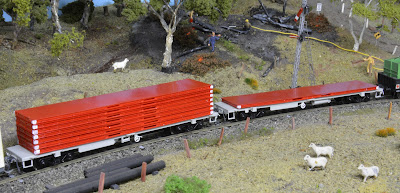
wagons were allocated to gas pipe traffic and reclassed PCUYP. The wagons were fitted with Dhatec System 88
pipe frames. 25 of these wagons were sold to Queensland Rail for spoil traffic
in 2013 reverting back to PCUY class.
PCO/PCOP/PCOY/PCUY wagons
were used across the network on most trains at various times. The wagons were
used in the following traffic.

Longreach.
Winton Gypsum Traffic. 2016
Winton – North Queensland
gypsum traffic via Rockhampton.
Coal traffic Mackay
area
Charleville – Fisherman’s
Island export goat meat.
Tycamba (Dalby) –
Fisherman’s Islands seafreighters.. Included Oakey and Toowoomba.
Wallangarra – Fisherman’s
Islands export meat from the New England area of NSW.
Replacing PYC/BAUY wagons
on the Goondiwindi cotton trains around 2013.
Ballast/Spoil Trains SEQ
Area.
Around 2016, the class
was used to upgrade cattle trains to 100 km/h with new containers.

Sleeper Trains

Central Queensland Q-Link Traffic Longreach 2016.

BHP Steel Traffic (NCL) and Mt Isa Line (Acacia Ridge 2002).

QRX Traffic Moolabin.

PCUYP Wagons (Pipe Traffic) Oakey 2013.


SEQ Spoil Wagons. 24/25 PCUY wagon in Clapham 2019.
These wagons/containers replaced the HSA wagons a couple of years ago.

New Cattle Containers on PCUY Wagons (Photo North West Star Sally Cripps)
PCUY 45297 was fitted
with main reservoir pipes by Walkers at Maryborough in 2018 and was reclassed PCUYM.
The marking on the wagon included a red diamond superimposed with a white 100.

Photo Carl Millington
PCUY
Wagons on Westgate.
Having purchased two SRM
2300 class DEL’s, I needed rollingstock around that era. Most of my wagons on
Westgate reflect QR in the 1960’s. Some of the early steel wagons were still in
service when the 2300’s entered service in 1997, but with different markings
and some had modifications like buffers removed etc.
2300 class locos mainly
worked coal, grain, container, freight train and the A/C passenger train. I do
not have later era grain or coal wagons or A/C passenger cars and if I did they
would look a bit out of place on the layout. There is so much one can do with
container and they offer endless small projects. One set of wagons and a box of
containers allows you to have a different train each time you run a train, just
swap the containers around, it’s so easy. Plus the choice of containers is
endless, with various types, colours and markings. If you are into scratch building
there is endless opportunities to put your own stamp on the train. Having a
standard gauge container train gives me a supply of containers to draw on to
swap around from time to time. Plus, today there is a great range of Aussie
containers across various eras on the market today, many of them were conveyed by
rail in Queensland.
So it looks like container
wagons are required to supplement other wagons that could be used for a modern
train. I used Peco track on the layout which give me a 24” radius curves on
points, smaller wagons would look better than long wheelbase wagons and give
less trouble. I was also looking for something simple to build with little
work. A basic model with minuim detail that looks the part from a distance is what
I was looking for. At the end of the day
if the wagon was loaded with containers, you cannot see the open wagon floor. In
the cupboard was a draw of SRM bogies waiting for a job. Checking various plans
the simplest wagons to build were the PCUY wagons, a two slot container wagon.
The wagon floor was made
from .040” styrene sheet. The width was reduced by 1 mm to accommodate the sole
bar that will be added. Some had the open sections were cut out on one end for
a single container load. Frist contract PCO wagon diagram was used as a guide. “A”
end is different to “B” end, brake gear is visible on the “A” end. “B” end is
the handbrake end, this is something that changes from time to time. There was
a time when “A” end was the handbrake end. I often mark one end of my model to
assist keeping thing in perspective. Working on models upside down can toss you
at times. A sketch is great aid as well.

The headstock across the
ends was Evergreen #127 .020 x .156. The solebar along the sides was Evergreen
#8206 H0 2” x 6”, trimmed to correct length. The pivot beam for the bogies was
added between the solebars according to the bogie centres on the plan, these
were Evergreen #167 .080 x .156. The bogie rubbing pad was Evergreen # 127 .020
x .156, the king casting of sorts. To keep the floor/wagon straight, a centre
sill was added between the two pivot beams. Along the underside of the floor
Evergreen # 156 .060 x .125 was added. On each side of this the same size strip
was added, the ends will need to be sloped back to the same height as the pivot
beam to accommodate the bogies.


Detail was added to my liken,
brake cylinder and counter lever slide were AR Kits brake bits, the reservoir was
made from Evergreen tube #226 3/16”, with # 154 .060 x .080 strip inserted in end
for the triple value. Some styrene rod was added to remove the block look. Brake
wheels were Model Etch ME 77, 5 spoke. Steps on each end were Tichy Train Group
# 3076 Freight Car ladders cut to size, these are a bit oversize and not quite
to the same profile. I added steps as I feel they make the wagon look smart. The
container mounting pads on the side were made from Evergreen #8206 H0 2” x 6”
strip. Supports were added using some smaller size strip. Coupling
release levers were made from Mains West BWR 12 .12 thou brass wire available
from AR Kits. Steel strips on the deck was made from .005 thou styrene cut
to size, this I found in a chocolate box
used to separate the trays.
The wagons were placed on
the scales and came in at 20 grams, for me this is somewhat light. I like my bogies
wagons around 50/60 grams. Plumbers sheet lead about 1mm thick was cut to size
and super glued to various areas of the floor out of sight. If I make any more
I think I will use .030 thou styrene for the floor. When finish the wagons were
again placed on the scale coming it at 35/36 grams without a load. After adding
the lead the wagons were added to the front of a 22 wagon train on the layout,
32 wagons in all on the train. The wagons did not derail, but were at their
limit, some consideration will be needed with the loads being added to the
wagons. All up nine wagons were built, I find doing a batch of wagons allows
you to cut all the components together and allows you to move from wagon to
wagon giving the solvent time to set.
During the construction
of the above wagons I came across the Wuskie Models PCUY wagon kit at a buy
& sell for $ 5.00. The hot water method to straighten the body didn’t give
me a straight frame, some parts of the solebar in the open areas bowed outwards.
These parts were cut out and replaced with brass strip. The centre sill was
reamed out and a solid brass bar was glue in out of sight. I had used this
method before to keep my FNH QFC wagons straight and add a bit of weight. The
pivot bean was milled down in the drill press to reduce the height to a similar
floor level as the other wagons. The kit has better detail than the wagons I
build from scratch.
Decals need to be made and
weathering will come later.
So container can be
interchanged from wagon to wagon when I built the standard gauge train back in
the 1980’s, I made a 20’ container base template from shim brass sheet. Corner holes
were drilled which would me a consistent position for drilling mounting holes.
.020” brass wire was glued into the container base to hold the container to the
wagon. I found different manufactures making containers can have different
lengths for the same size containers. Some Australian manufactures have
mounting holes in the container base to accommodate moulded twistlocks on their
wagons. If you were not planning to move your containers around your fleet,
they can be fixed them to the wagon floor. There are various manufactures of
containers, some have been around for many years, I found some do not line up
with mounting pads on the wagon. Some containers I used centre mounting pins, one
each end to stop the container moving around during travel on the layout.

Overall the project was
to use components and parts I had in the draws without going shopping. The
bogies have oversize wheels for this type of wagon and using the .040” styrene
for the floor lifted the floor height by about 1.5 mm above the correct height.
Over all I feel they look the part and the 2300’s will look more at home on the
layout, but I let you be the judge.


SCFU Containers as used in BHP and Mt Isa Line Traffic.
I located the photos after they were built??

K & S Flat Racks.


Made from photos off the internet.


All wagons are in a
train on the layout, check out the train on YouTube. https://youtu.be/6qfTu-xQxlU
Arthur H.


