Monday, 14 August 2023

Track Cleaning Cars.

Operating your layout is a ton of fun when everything runs without issues. Dirty track and wheels have the potential to turn your day upside down with stop start running and derailments.  Having clean track on your layout makes the layout more reliable and enjoyable. Over the years there has been various methods and it can be time consuming taking the shine off operating the layout.


For many years I used a track cleaning rubbers, Peco, Fleishman, and a few others. At times a fine grade wet and dry paper has been used on heavy stained areas. Reading various reports, some say track cleaning rubbers causes’ damage to the top of the rail and over time causes other issues. In short this is called the “Dry” method. This method leaves small particles of the rubber behind, a type of dust from the rubber that’s lays on the track that can find its way into mechanisms, rollingstock etc. adding additional tasks to maintaining the layout. Usually, the vacuum cleaner comes out for a run over the track. Scrubbing the track with a rubber and then waving the vacuum cleaner around can cause damage to structures near the track in the rush to complete the task. Because of this some detail has been placed away from the track or left off the layout. Having said that, from time to time it’s a good idea to run the vacuum cleaner, with care, over the layout to pick up dust that has come in from outside. I also use a soft brush on the roof of buildings and rollingstock on the layout. I usually loose a few people and small detail from the layout in doing so. And then there is the tracks in hidden areas like tunnels or out of reach etc. I found if the layout was not used regularly, the track cleaning rubber on the track was required before running trains. Track cleaning cars can help and there are many to pick from. 

For the standard gauge network on the layout I did modify a Bachmann Silver Series item # 16301 “Track Cleaning Car Weed Sprayer Service” tank car to look Australian. 


Several different models in various colours/railroads are available. Various parts were removed and others added. 
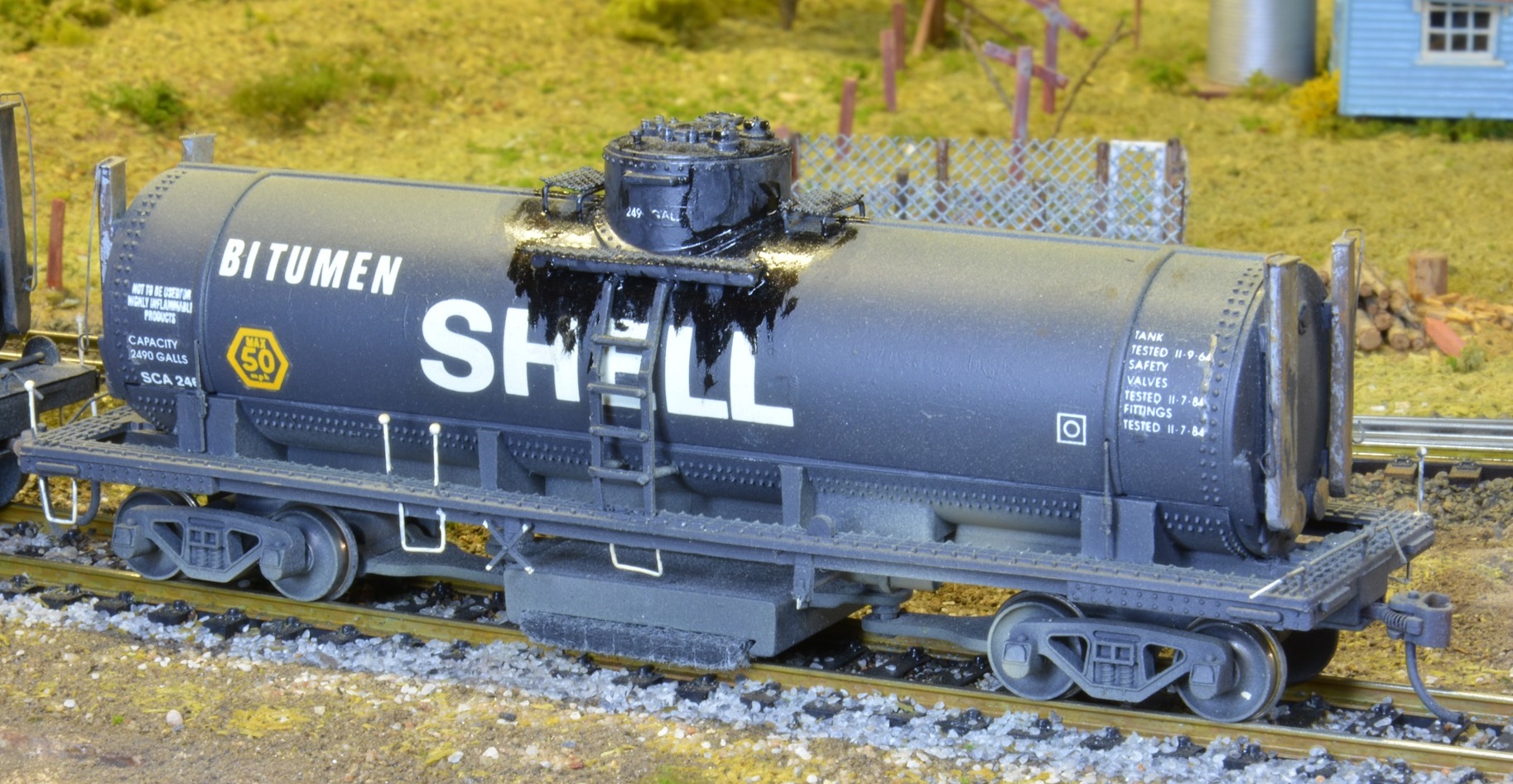

Steps, handrails, platforms, burner tubes, coupling release handles etc. painted and decals were added, a bit of weathering to make a bitumen tanker. In general, the wagon were given a NSWR flavour. 

A second one (later era) was modified for a mate, this time the underframe was also altered.


Over time the rubber did clogs up and I was able to purchase a replacement. Using the car after lengthy periods of not running I found I still have issues with some steam loco not wanting to run and a deeper clean was required.   

The other way modellers have reliable running is using the “wet” method, this is adding a fluid to the rail to improve the flow of electric current between the track and the loco motor. Wahl clipper oil was popular a few years back and is still used by some modellers. To me, oil on the track may keep a shiny top, but does it help conduct power to your locos. Plus the dust factor in the layout room, oil and dust together becomes a grinding paste. Yes, I can hear you saying, oil on the track. I recall when working at the Gabba, some Cleaner would put oil on the track after the coal stage when another Cleaner (he should have been help us) was driving a loco, it was up hill back to the shed roads. Yes, there was some wheel spinning, a few words and a bit of skill (a few attempts) required from the driver to make it up into the yard. When working the QR “N” scale layout on tour in the 1980’s I found the dry method didn’t work all that well in wet weather. I used WD 40, spray it on a cloth, wipe the track with the cloth and then wipe the track with a clean cloth. Trains with two working locos did climb a spiral on the layout. Have said that, black scum did build up on the wheels that needed to be cleaned off. If allowed to build up to much, derailments were the order of the day. In recent times CRC 2-26 and INOX – MX3 are has been used, I understand both of these products are used in maintaining reliable operations of electrical equipment including railway signalling. 

A local modeller just down the road, Gregg from Fishplate Films has done a couple of videos on tracking cleaning, very entraining and lots of information for consideration. Since watching Gregg videos a couple of years back I have been using INOX-MX3 on the track. I can go to the layout any time, and trains well run. Sometimes there may be a few weeks between turning on the power, trains still run. Cannot recall the last time I have had to cleaned wheels on rollingstock. Locos have their wheels cleaned when they are serviced from time to time. 

I don’t think one method can be used on all layouts, I feel the location of the layout and the environment along with general weather conditions you live in, on the day will play a part in how your layout will run. Some products are good for a deep clean of the rail head, others help with the flow of power to the locomotive. Some will be good in some applications and not so good in others. And then there is your style of train operations, long trains winding up grades to short trains on a flat shelf layout. Some locos may be fitted with traction types and other are not, some solvents may cause damage to them.  

Recently, I was given an article published in the NMRA Magazine “Track Dirt Science” written by Paul Welsh. The article covered everything from sludge accumulation, rail tarnish, rail scratches, wheel scouring, know your enemy, Wet and Dry rail philosophy, track cleaning cars, cleaning wheels, cleaning solvents volatility, effects of solvents on locomotive adhesion down to having a scientific dirt management program. 

Several years back I did purchase a Centerline track cleaning car for the standard gauge section of the layout and have never used it, I think at the time of purchase it cost around a $100.00. The question I keep asking myself, what’s the best practice for using this car and I kept coming up with different answers.


Gwydir Valley Models (Glen Inners NSW) website show the following Centerline products:-

Rail Cleaners in “N”, “H0-3”, and “H0”. Replacement knurled brass rollers, elastic bands and roller covers. http://www.gwydirvalleymodels.com/ 

The “Track Dirt Science” article shows how to build a number of tracking cleaning car. This was another matter I have been tossing around for years for the H0n3½ QR network on the layout. What wagon can I built and how to fix a pad that rubs on the railhead. 

Thanks Craig for the article, hear go. Some time back Craig had a number of knurled rollers made by a relative, much the same size as the Centerline roller car. I purchased two of them to do something with one day.  After purchasing the rollers I did make one car for them using styrene, after it sat around on the bench for a few months it started to bow. That’s a bugger @@###$$%^. I think too many alteration and to much solvent may have contributed to the bow.


After reading the article a number of times I decided to build three cars changing my construction method. The article shows three different types of blocks/pads being used to clean the track. 

My cars were built from styrene, sub end frames were joined using Evergreen strips to have an open pit between the bogies. 


Lead sheet was added to each end to assist in keeping the wagon on the track.


One car was made with all sides of the pit the same clearing the top of the rail by 2 mm. 


The cars were painted with some left over SMS Paint.

 On the scales, the wagons weight in between 62 / 64 grams.

One car was made for the roller, a smaller opening in the centre.


A Chux “Superwipe” section was cut into 26 mm wide strips. The strip was wrapped around the roller and secured with a small strip of masking tape. A small rubber band will do the job also. The masking tape didn’t stay in place for long once the solvent was added, maybe, I should wrap the masking tape fully around the roller bring it back onto its self??. If planning to run in one direction only, the Chux strip does not require securing if the roller is placed in the car with the end of the strip trailing. Spare Roller Covers are available from for Centerline track cleaning car as well if you don’t like the idea of making your own.

Another part of the project was to make homemade decals with my jet ink printer.

The second car was make to take timber block, fitted with Chux “Superwipe” strip the same dimensions as the roller.  The pad can be used wet with cleaning fluid or dry same as the roller car. 


The timber blocks were made from a stick of 42mm x 19mm dressed pine cut to be 25 mm wide. Not knowing how dirty the cleaning pads would end up, a number of extras were made with the saw in action. This would give me spares to change at any time without stopping to change cleaning pads. Two 19 mm foldback paper clips were secured to the top of the block with a screw to hold the Chux wipe strip into place. When adding the Chuck strip, a Masonite block (same size as below) was sandwiched onto the timber block, rough side down. The Chux “Superwipe” strip need to be tight on the block, if loose, you may find it will catch on points.


 This wagon could be used similar to the roller car. 

The third car with built with a full centre pit that cleared the rail by a few millimetres to take Masonite blocks. 

A 25 mm strip was cut from a 4.8 mm thick Masonite sheet. The strip was cut into small blocks 42 mm long.  When in the track cleaning car the rough side goes down onto the track. The pit on the wagon will take a number of blocks, this helps with a bit of weight to keep bottom block on the track. Nothing new about this method, it has been around for years.


A number of pads were also made from a paint edger pad, these were cut to size using heavy duty scissors, 25 mm wide by 42 mm long. The pads are 5mm thick and fits in the same car as the Masonite blocks. Two refill pads in a pack are available from Bunning hardware stores for under $8.00. Masonite blocks were added on top the paint pad for weight and to keep the pad in place. 


The blocks and pads can be used on both the H0n3½ and H0 track systems.        


For the first test run the train was set up with the paint pad in front of the loco (Car # 3) to clear dust etc. from the track. 

Behind the loco was the roller car (Car # 1) with a few drops of INOX on the pad, followed by a car # 2 with a dry pad. 

Below is the results after four laps of the layout. 


I also had a play around with the H0 Centerline car, changing the bogies, the H0 Kadee bogies were removed and replace them with Southern Rail H0n3½ bogies. The side mounting lugs on the Kadee coupler were removed to allow the bogies to turn. The car worked well on the layout coupled to the other track cleaning wagons. 


For sidings I plan to use a push/pull, dry pad, roller with cleaning fluid, and a dry pad.  

I guess only time will tell how well the method will work and how much time it will save me from cleaning track. 

I would still like to explore a method using prototype wagons with pads etc., fitted to the underframe. Some time back I did try “clip on” wheel axle pads, these were light (plastic), a small piece of lead sheet was added to the top, this did improve things a little. They needed to be removed for cleaning and the whole thing was a bit messy. 


Noch # 60159 TT Track cleaners, there is 5 to a pack. Noch also make them for “N” and “H0” scale track. Woodlands Scenics make a H0 scale Dust Monkey that is very similar. 

Well, that was issue # 100, I trust you find the information helpful for your railroad/railway/layout. Thank You for your all your support and comments, they are all appreciated. I look at the stats from time to time that Blogger provide, and the numbers and countries that view the blog are mind blowing considering QR is not a large rail network on the world stage. 

It’s been a long time since I have done anything to the layout, like us with age, things start to fall apart. And there is the other side of the coin, modelling has improved so much in the last decade along with standard of modelling. Next time we will look at what’s happening on the layout.  A little clue below. 


Until next time, stay safe and enjoy your modelling. 

Arthur H.  

Acknowledgements.

NMRA Magazine “Track Dirt Science” by Paul Welsh.


Wednesday, 12 July 2023

BBV Guard's Van

Over a nine-year period, no fewer than 80 BBV class Guard’s Vans were build and entered service between 1952 and 1961. The vans were the most numerous of the wooden vans and the last wooden van to enter service. The vans were 32 ft. long and to the eye they all looked the same. Two small passenger compartments that carried 10 - 2nd class passengers each. The other end was open to carry goods and parcels with a dog box down one end, and the usual Guard’s lookout and equipment was near the centre next to the passenger compartment. When built the vans were allocated to a division similar to steam locomotives at the time. These locomotives worked mainly between depots within the division due to coal capacity. The Guard’s Van remained on the train until reaching the trains’ destination, working through a number of depots. At the time most goods trains started and finished within the division.  Some the vans were modified for mineral and coal traffic, most remained in service to the late 1980’s, early 1990’s being replaced by Two Driver Operations (TDO) when Guards Vans were removed from trains.   


The vans were built in three batches. Lets’ look at the history cards which will give a better understanding of changes during their service and areas of operation. This could be helpful when modelling an era or a location. 

Batch #1. Vans 1542 – 1561.

The vans entered service as Goods with 2nd class passenger accommodation (BGV class).  

Bogies – Angle Iron, plain bearings.

Guards compartment fitted with wash basin and 7¾ gal water tank.

Wooden Lookouts.

Classified BBV in 1953.

Grab handles etc, provided for Guard to reach end of van in 1958.


Number

In Service

Division

Written Off


1542

Mar 1952

SED

July 1989  (SD)

Apr 1971 Converted to Periscope Van Ipswich W’shops. QR 17 A bogies. Toilet & washbasin in Guards compartment, 50 galls tank, two gas cylinders fitted.

Fans fitted Dec 79.  

Plans indicate the rear window was added when the gas cylinders and cooking ring was relocated.  

Number

In Service

Division

Written Off


1543

Mar 1952

CD

Jun 1989 (ND)

May 1970. Fitted with folding writing shelves

Mar 1973. Fans fitted.

Aug 1975 Fitted with gas heater and cooking ring Aug 75.


The class “BBV” above the number was added in later years on some vans, 1970 onwards


This van shows on the lookout to be used on the Brisbane Valley only.


Number

In Service

Division

Written Off


1544

May 1952

CD

Jun 89 (Twba)

Nov 1972. Test paint Dulux. Fans fitted. 

Jul 75 derailed Sarina.

May 78 Fitted with gas heater and cooking ring.


Number

In Service

Division

Written Off


1545

May 1952

ND

Jan 89 (Ips)

Jun 86. Derailed Wyreema.


Number

In Service

Division

Written Off


1546

May 1952

ND

Oct 78 (CD)

May 75. Fans installed.

Oct 75. Derailed Sarina


This van has the “second” on the doors.


Number

In Service

Division

Written Off


1547

May 1952

SWD

Service 11/88.

Sep 75. Derailed Maryborough District.

Jul 77. Derailed Northern Division.

Nov. 86. Derailed Mt Surprise – Einasleigh Section.

Part of the Mary Valley Rattler fleet.


Mary Valley Railway


Number

In Service

Division

Written Off


1548

May 1952

SWD

Feb 1989 (CD)

Oct 80. Fitted with gas.

Sep 83. Self contained buffers fitted one end.


Number

In Service

Division

Written Off


1549

Jun 1952

Corner missing

Dec 86 (Ips)

Nov 76. Collision FJS 28070 Carmila.


Number

In Service

Division

Written Off


1550

Jun 1952

Corner missing

Mar 90 (Ips)

Mar 67. Damage Goondiwindi Area.

Jan 75. Derailed Bluff.

Feb 83. Toilet Instilled.


Number

In Service

Division

Written Off


1551

Jul 1952

Corner missing

Feb 90 (Twba)


Number

In Service

Division

Written Off


1552

Aug 1952

CD

Jul 89 (Twba)

Nov 80. Fitted with gas.


Number

In Service

Division

Written Off


1553

Aug 1953

ND

Oct 89 (Ips)

Mar 81. Gas fitted.

Sold – Laidley.


Number

In Service

Division

Written Off


1554

Sep 1952

ND

Jun 89 (Twba)

Jun 80. Gas fitted.


Number

In Service

Division

Written Off


1555

Sep 1952

SED

Aug 89 (Ips)

Aug 79 Gas Installed.

Nov 83 Toilet installed. Self-contained buffers fitted one end.


Number

In Service

Division

Written Off


1556

Oct 1952

Corner missing

Oct 89 (Ips)

Dec 89. Gas Installed.

Aug 89. Sold Caboolture.


Number

In Service

Division

Written Off


1557

Oct 1952

SWD

Mar 90 (Ips)

Sep 81. Toilet & Gas installed.


Number

In Service

Division

Written Off


1558

Oct 1952

SWD

Jul 89 (Ips)

Nov 77. Derailed Oorindi

Mar 80. Gas fitted.

May 86. Derailed Dutton Park.


Number

In Service

Division

Written Off


1559

Nov 1952

CD

Jun 89 (Twba)

Nov 73. Electric fan fitted.

Apr 77. Derailed Kingaroy – Wooroolin section.

Feb 80. Fitted with gas.

Feb 87. Standard Guards lookout fitted. QR packed bearings fitted.


Number

In Service

Division

Written Off


1560

Dec 1952

ND

Jul 89 (Ips)

Oct 70. Converted to Periscope Van. National Indust bogies. Auto couplers etc.

Jun 78. Gas fitted.


Number

In Service

Division

Written Off


1561

Dec 1952

SWD

Oct 88 (Ips)

Oct 74. Overhauled R’ton

May 81 Gas installed.

Batch # 2 1582 – 1631.

Underframe & Bogies Com-Eng. Body made and fitted Ipswich Shops.

Bogies QR 1. (Plain Bearings)

Washbasin & Toilet in Guards Compartment. 50 gall water tank in roof.

Steel Lookouts.

C.S.S.C. Buffers. 

Grab handles etc. provided for Guard to reach end of van 1958.

Stops welded inside axle boxes and lugs on lids Aug 1958.

Bolster and Snubber springs modified 1969. 

Periscope Van modifications. (as per 1585).

Roof periscope type lookout, Underframe reinforced and ballasted Tare 24 T (only vans 1585, 1597 1599).  Ascending steps and roof handrails. BK heavy duty draft gear BK (Same as VAO contract). Dog box removed and 2 x 20 lb gas cylinders positioned with one single burner gas ring on a stainless shelf with stainless steel splash back. (Insulated with ¾” fibre glass). Protective padded shield built around hand brake column and wheel fitted in lieu of crank bar to operated handbrake. Walls of van covered in 4” and 2” plastic foam trimmed PVC protection of Guard.    


Number

In Service

Division

Written Off


1582

Nov 1955

SED

Jan 89 (Tve)

Jan 69 Rockhampton. Bolster and Snubber springs modified


Number

In Service

Division

Written Off


1583

Nov 1955

CD

Feb 90 (Twba)

Mar 73. Fitted with “Ritter” Fans

Jul 75. Collision with van 1544 Sarina.

Jun 80. Gas fitted.


Number

In Service

Division

Written Off


1584

Nov 1955

ND

Oct 88 (ND)

Jul 68. Fitted with Auto couplers, Periscope fitted.

Oct 69. Guard’s lookout repositioned.

Aug 83. Gas re-located. 


Number

In Service

Division

Written Off


1585

Dec 1955

SWD

Jan 89 (Ips)

Jan 57. Derailed Murphy Creek.

Mar 58. Handrail, step boards, etc. fitted.

Dec 67. Modified to Periscope Van.

Jan 68. Bolster & snubber springs modified. Auto couplers fitted.

Oct 70. Fitted with 8” Davis & Metcalf triple vale.  

Apr 76. Derailed Emmet.

Feb 77. Derailed Moura.


Number

In Service

Division

Written Off


1586

Dec 1955

SED

Aug 89 (Gympie)

May 81. Fitted with gas.


Number

In Service

Division

Written Off


1587

Dec 1955

CD

Jul 89 (Ips)

Apr 77. Fitted with gas.


Number

In Service

Division

Written Off


1588

Mar 1956

ND

Mar 89 (R’ton)

Apr 57. Derailed and badly damaged CD.

May 87. Derailed Butre ND.


Number

In Service

Division

Written Off


1589

Mar 1956

SWD

May 89 (Ips)

Aug 84. Bogie changed to QR 1 packed bearings.


Number

In Service

Division

Written Off


1590

Mar 1956

SED

Aug 89 (Ips)

Jul 68. Modified to Periscope Van with Auto couplers.

Nov 69. Relocated of end wall equipment. Fitted additional padding on end wall. Relocated of gas cylinder recess

Jul 79. Derailed Guthalungra.

Aug 81 Gas heater fitted.

Sep 83. QR 1 package bearings fitted.

Dec 84. Sunvisor fitted.


Number

In Service

Division

Written Off


1591

May 1956

CD

Feb 89 (ND)

Aug 80. Gas fitted.


Number

In Service

Division

Written Off


1592

May 1956

ND

Oct 89 (Ips)

Mar 81. Gas fitted.

Jul 86. QR 1 package bearing fitted.

Aug 89 Sold – Laidley. 


Number

In Service

Division

Written Off


1593

May 1956

SWD

Aug 89 (Ips)

Sep 80. Gas fitted.


Number

In Service

Division

Written Off


1594

Jul 1956

SED

Aug 90 (Ips)

Jun 68. Periscope fitted.

Nov 68. Auto couplers fitted  


Number

In Service

Division

Written Off


1595

Jul 1956

CD

Apr 88 (CD)

Jul 66. Fitted auto couplers for Moura Tfc.

Jun 78 Derailed Rosewood.


2nd class was changed to Economy class early 1970’s.

There was no marking for economy class. 


Number

In Service

Division

Written Off


1596

Jul 1956

ND

Jul 89 (ND)

Mar 78 Derailed Thinoomba – Brooweena

Sep 79. Gas fitted. 

Mar 86. Derailed Muckabilla – Hodgson


Number

In Service

Division

Written Off


1597

Sep 1956

SWD

Jun 88 (Ips)

Apr 68. Fitted Auto couplers. Periscope fitted.

Oct 69. Additional padding , relocation of gas cylinders

Sep 72. Derailed Gladstone.


Number

In Service

Division

Written Off


1598

Sep 1956

SED

Jul 89  (Ips)

Feb 70. Converted to periscope van.

Mar 86. Sunvisor fitted to periscope.


Number

In Service

Division

Written Off


1599

Sep 1956

CD

Oct 88 (Ips)

Apr 68. Auto couples, periscope fitted.

Jun 69. Underframe reinforced and ballasted to 24 T, snubber springs have been varied to ensure softer riding quantities. . 

Dec 81. Heater installed.

Jul 84. QR 1 Package bearings fitted.

Aug 84. Sunvisor fitted.


Number

In Service

Division

Written Off


1600

Nov 1956

ND

Jan 87 (CD)

Oct 66. Auto couplers fitted.

Nov 80. Gas fitted. 


Number

In Service

Division

Written Off


1601

Nov 1956

SWD

May 89 (SWD)

Mar 69. Modified to Periscope van.

Dec 84. Sunvisor fitted.


Number

In Service

Division

Written Off


1602

Dec 1956

SED

Aug 85 (Ips)

Sep 80. Gas fitted.


Number

In Service

Division

Written Off


1603

Mar 1957

SWD

Jun89 (ND)

Side handrail are being fitted as standard along with stops in the axle boxes.


Number

In Service

Division

Written Off


1604

Mar 1957

ND

Oct 80 (ND)

23.9.80. Demolished by Shell road tanker Woodstock level X crossing. Guard fatally injured.


Number

In Service

Division

Written Off


1605

Mar 1957

SWD

Jun 89 (M’boro)

Jul 80. Fitted with gas.

Nov 84. Fitted with QR 1 package bearing.


Number

In Service

Division

Written Off


1606

May 1957

SED

Aug 91 (Ips)

Jul 79. Fitted with gas.


The division was shown on the end of the van with the number and tare weight.


Spring Bluff, being used by the local Lions club as a kiosk. The van disappeared after the 2011 floods.


Number

In Service

Division

Written Off


1607

May 1957

CD

Aug89 (Ips)

Jan 81. Fitted with gas.


Number

In Service

Division

Written Off


1608

May 1957

ND

Aug 89 (Ips)

Oct 66. Fitted with auto couplers.

Apr 80. Bracing brackets, gas fitted.

Nov 88. Derailed Forsayth


Number

In Service

Division

Written Off


1609

Jul 1957

SWD

Jul 89 (SWD)

Feb 76. Derailed Mt Morgan.

Jan 82. Fitted with gas.

Dec 86. General overall.


Number

In Service

Division

Written Off


1610

Jul 1957

SED

Nov 72 (CD)

Sep 72. Damaged Gladstone beyond repair.


Number

In Service

Division

Written Off


1611

Jul 1957

CD

May 90 (Ips)

Sep 66. Fitted with auto couplers.

May 78. Gas fitted.


Number

In Service

Division

Written Off


1612

Sep 1957

ND

Aug 89 (Ips)

Redbank Workshops 12 – 18 Oct 65. Aux. drive gear box. Modification – Telephone box installed. This was also shown for 1613 with other mods relating to locos, was ruled out. ??

Number

In Service

Division

Written Off


1613

Sep 1957

SWD

Jun 89 (M’boro)

Nov 69. Modified for Moura Traffic. Periscope fitted.

Jul 74. General Overhaul. R’ton.

Jan 84. Derailed Proston.

Oct 84. Sunvisors fitted.


Number

In Service

Division

Written Off


1614

Sep 1957

SED

Sep 94 (Ips)

Mar 69. Fitted with periscope.

Oct 81. Bracing brackets fitted, Guards seat and head rests modified, 40 lb gas fitted.

Oct 84. Sunvisors fitted.

Apr86. QR 1 packed bearings.  


Doomben Apr 87.


Number

In Service

Division

Written Off


1615

Oct 1957

CD

Aug 90 (Ips)

Packing plates transferred from bogie to underframe.

Mar 63. Bogie modification.

Jun 68. Periscope fitted.

Nov 68. Auto couplers fitted.

Nov 74. Derailed Koonkool (CD).

Mar 76. Derailed Earlsfield. (CD)

Oct 80. Fitted with bracing brackets, Gas heater and rings, Guards seat table.


Number

In Service

Division

Written Off


1616

Nov 1957

ND

Aug 89

Oct 59. CSSC Buffers modified.

Jul 80. Gas fitted.

Sep 81. Bracing bracket fitted, Guards seat & squabs

Jul 85. Derail Bowen – Merinda.


Number

In Service

Division

Written Off


1617

Nov 1957

SWD

Jun 91 (Ips)

Jul 66. Fitted with auto couplers for Moura Tfc.

Feb 75. Derailed Bluff – Parnabal section.

Aug 85. Derailed Emerald. .


The QR logo was introduced in 1970 and was added to rollingstock during workshop visits soon after.


Number

In Service

Division

Written Off


1618

Feb 1958

SED

Jul 91 (Ips)

Sep 66. Auto couplers fitted for Moura Tfc.

Dec 73. Fitted with fans.

Jun77. Seats improved.


Number

In Service

Division

Written Off


1619

Jan 1958

CD

Jan 89 (Tve)

Mar 73. Guards seats and backs modified.

Dec 74. Derailed Tunnel – Gogango section.

Aug 79. Bracing brackets, gas ring & heater, fan, new toilet & washbasin fitted.

Feb 81. Derailed Cambooya – Nobby section.

Jun88. Derailed Einasleigh – Forsayth Section.


Number

In Service

Division

Written Off


1620

Feb 1958

ND

Feb 89 (Ips)

Jul 77. Bracing brackets fitted, seats improved.

Sep 79. Both headstock straighten, renew plates.


Number

In Service

Division

Written Off


1621

Apr 1958

SED

Dec90 (Ips)

Oct 66. Fitted with auto couplers

Dec 70. Periscopes fitted.

Sep 82. QR 1 bogies changed to QR 3 with packed bearings.

Sep 84. Sunvisors fitted.


Number

In Service

Division

Written Off


1622

Apr 1958

CD

Mar 89 (R’ton)

Feb 87. Packed bearing fitted.


Number

In Service

Division

Written Off


1623

Apr 1958

ND

Jul 89 (Ips)

Aug 80. Gas fitted

Dec 83. Derailed Ilfracombe section.

Oct 88. Derailed Forsayth – Einasleigh section.


Number

In Service

Division

Written Off


1624

Jun 1958

SED

Jan 88 (Ips)

Apr 63 Bogies modified.


Number

In Service

Division

Written Off


1625

Jun 1958

CD

Jul 80 (Ips)


Number

In Service

Division

Written Off


1626

Jun 1958

ND

Jun 89 (Ips)

Nov 72. Derailed Duchess section.

Oct 76. Derailed Bundaberg yard.

Jul 81. Gas fitted.


Number

In Service

Division

Written Off


1627

Jul 1958

SED

Mar 90 (Ips)

Jul 77. Fitted with Auto Couples Moura Tfc.

Sep 79. Bracing brackets, gas ring & heater, mods to Guards seat.

Aug 84. QR 1 packed bearing fitted.


Number

In Service

Division

Written Off


1628

Aug 1958

CD

Mar 89 (R’ton)

Aug 80. Gas fitted


Number

In Service

Division

Written Off


1629

Sep 1958

ND

Aug 89 (Ips)

May 68. Modification of bogie springs.

Jun 68. Periscopes fitted.

Nov 68. Auto Couplers fitted.

Jun 80. Gas fitted, bracing brackets, Guards seat modified.

Mar 86. Sunvisors fitted. 


Number

In Service

Division

Written Off


1630

Oct 1958

SED

May 89 (Ips)

Jun 65. Radio & Auto couplers fitted for Mt Isa Project.

Mar 79. Derailed Toolooa yard.(Gladstone)

Jul 79. Radio aerial cut off (working electrified areas,)  

May 82. Overhaul & painted Tve.


Number

In Service

Division

Written Off


1631

Sep 1958

SED

Jul 88 (Ips)

Dec 65. Radio and auto couplers fitted for the Mt Isa Project.

Aug 79. Collided with ford cortina Emerald.

Sep 79  Collided with ??? Bowen.

Sep 80. Gas fitted.

Sep 81. Collided with QGX Emerald.

Jul 82. Derailed Willows - Bogan section.

Sep 83. QR 1 packed bearing fitted.

Oct 85. Derailed Bullock Ck section.

Batch 3 Vans # 1632 – 1641.

QR 14 Bradford Kendall (cast steel) A.S.F. Ride control Bogies. 12 T.A.L. SKF roller bearings.

Underframe built by Scotts of Ipswich.

Bodies built by Ipswich Workshops.

C.S.S.C. Buffers.

Wash basin and Lavatory in Guard’s compartment.

50 gall water tank.

Steel Lookouts.

Link type screw couplings.


Number

In Service

Division

Written Off


1632

Jul 1961

ND

Jul 89 (Ips)

Apr 65. Auto coupling and Radio equipment fitted charged to Mt Isa Fund.

Oct 73. Electric fans fitted.

Jul 79. Radio Aerial removed.

Jul 80. Gas fitted.


Number

In Service

Division

Written Off


1633

Jul 1961

ND

Oct 89 (Ips)

Jun 65. Auto couplers and radio fitted for Mt Isa Project.

Nov 72. Derailed Cloncurry

Jun 74. General Overhaul Tve.

Nov 74 Ritter Fans fitted.

Dec 80. Bracing brackets, gas fitted.

Aug 81. Derailed Redbank. 


Number

In Service

Division

Written Off


1634

Jul 1961

ND

Mar 89 (CD)

Jun 65. Auto couplers and radio fitted.

Nov 78. Brake gear modified.

Jul 80. Gas fitted.

Sep 82. QR 1 bogies change to QR 3 with packed bearings ??


Number

In Service

Division

Written Off


1635

Jul 1961

ND

Nov 88 (Twba)

Jun 65. Auto couplers and radio fitted.

Oct 65. Modification to springing. Gross load reduced to 20 Tons.

Nov 73. Fans fitted. Mod to Guards seats and back.

Jul 79. Radio aerial removed.

May 80. Gas fitted.

Dec 83. Alpha Brake down van.


Number

In Service

Division

Written Off


1636

Jul 1961

ND

Mar 85 (Ips)

Jun 65. Auto coupling and radio Fitted.

Sep 74. Fans fitted.

Dec 74. Derailed Edungalba yard.

Nov 80. Bracing brackets, gas fitted.

Oct 84. Derailed Auckland Pt.


Number

In Service

Division

Written Off


1637

Jul 1961

ND

Jul 88 (Ips)

Jul 65. Auto coupling and radio fitted.

Jul 79. Aerial removed. (Twba)

Jun 80. Gas fitted.

Aug 88. Derailed Einasleigh – Forsayth.


In later years, sheeting instead of boards was used on some vans.


Number

In Service

Division

Written Off


1638

Jul 1961

ND

Aug 89 (ND)

Mar 63. Printed with special primer supplied by BALM.

Mar 65. Auto couplings and radio fitted.

Jul 79. Radio aerial removed.

Aug 80. Gas fitted.

Jun 83. Derailed Dullaca – Jackson section (SWD) Dynamo fell off. 


Number

In Service

Division

Written Off


1639

Jul 1961

ND

Nov 88 (Ips)??

Dec 65. Auto couplers and radio fitted.

Aug 73. Repairs to Guards seat, fans, shelves and wash basin fitted (M’boro)

Nov 78. Brake gear modified.

Nov 80. Gas fitted.


Number

In Service

Division

Written Off


1640

Jul 1961

ND

Mar 89 (CD)

Jun 65. Auto couplers and radio fitted.

Feb 78. Bracing brackets fitted.

Mar 79. Derailed Lapps section.

Sep 80. Gas fitted.


When converted to Radio Vans, a lighting flash with the “Radio” was added to the lookout and end of vans.


Number

In Service

Division

Written Off


1641

Jul 1961

ND

Fen 89 (Tve)

Jun 65. Auto couplings and radio fitted.

May 77. Derailed Pentland – Warrigal Section.

Jun 80. Bracing bracket, gas, Guards table, seats, toilet and basin fitted. 

Guards in the Northern Division (ND) were not over happy with the ride that these vans gave, they were of the opinion the freight bogies gave them a rough ride. Having travelled in the vans quite a bit in the late 1960’s the ride was far from Sunlander conditions. Trying to sleep stretched out along the seat was not a lot of fun on the back of a WHO train loaded with coal or ore.  From time to time one would wake up in transit to the floor. A full train of wagons fitted with auto couplers was new to most Guards going to the area for classifications.    

I recall one van spent a few weeks on it roof beside the track in the section near Homestead.

Markings.

Early 1970’s, 2nd class classification was replaced with economy class. During the 2nd class era vans and carriages were marked by a 2nd symbol, or in some had the word “SECOND” on the door. There were no markings for economy class.

After 1970, the QR Logo was added to the side in various locations.

Around the 1980’s, some vans had the classification “BBV” add above the number on the lookout.

Preserved.  

One van can be found at Gympie as part of the Mary Valley Rattler collection.

I understand there are two BBV in the Brooweena Historical Village and Museum. Vans 1605 and 1613 were written off at Maryborough. Maybe they are these two vans??? The website shows the village has the Brooweena railway station and goods shed. 

Model.

Give the numbers above, no QR layout should be without one or two. Looking at the January 1963 classes of coaching rolling stock there was 306 passenger vans in service. That’s 1 in 4 were BBV’s. 

Over the years there has been a number of models (kits) of the class, sorry, none of them were to my liking with various defects that would take a lot of time to correct or alter.  

The BBV van in this article is a Caintode Flats kit, paint and couplers is all that is required to finish the model. 


Hand rail knobs I made from brass rod supplied in the kit, some time back a pair of beading pliers were modified, one side was filled down to a much smaller diameter on the outside. The eye ring is made by twisting the rod around the new shaped jaw. Cal – Scale manufacture “Lift Rings” .012 wire, Part # 190-501, 20 to a packet. Detail Associates also do a similar product, # 2206 Eye Bolts - 3½” dia. wire formed. Tichy Train Group manufacture a plastic “Eyebolt” # 3037 similar in size. Insect pins are used where I want chrome hand rails, they are stainless steel, don’t use your best set of side cutter to cut them to length. They are added after painting.       


The kit comes with etched nickel silver steps (running board) brackets which makes things very easy. In the past I used standard staples cut to size, this may explain the ups and downs in previous models.


Hand rails/Steps on the end were folded up using a Keiran Ryan Models KRM Misc. 001 Bending & Drilling jig. The $6.60 investment was well worth it and is a dream to use, instructions are on Keiran’s website. .


The kit was assembled in the usual method, the roof was made to be detachable and is held into place with a 2 mm screw under the floor. Passenger compartments, seats and a couple of passengers were added


Photos show an extra smaller battery box as well as the larger box, this was made and added to the underframe.    


White step treads were added on one side only, a later era. .010” styrene strip was cut to length and added after painting.   

I did stuff up the paint job a little in applying the decals, the price one pays for being in a hurry. A black wash was applied in an effort to try and hide my errors, and we all know that was another blue. Overall, the construction of the van was similar to the “Southport” CLV van back in March 2023 blog posting. 

Given one in four passenger vans on the QR network were BBV’s, I have some catching up to do and will need to add a few more. A very nice model and a joy to do.  

Trust, you found something that was usefully for your modelling endeavours. Many thanks for your support and for checking out the blog. Until next time we hit the tracks on the layout, enjoy your modelling and have fun.   

The next post will mark 100 posting. I will need to find something special?? 

Acknowledgements.

Brake Vans of the Queensland Railways 1864 - 1980 by John Armstrong.

QR “List of Coaching Rollingstock” 3rd January 1963.

QR Plans

Queensland State Archives

Australian Model Railway Association Queensland Library

Rob Farlow Photo Collection.


Arthur H.