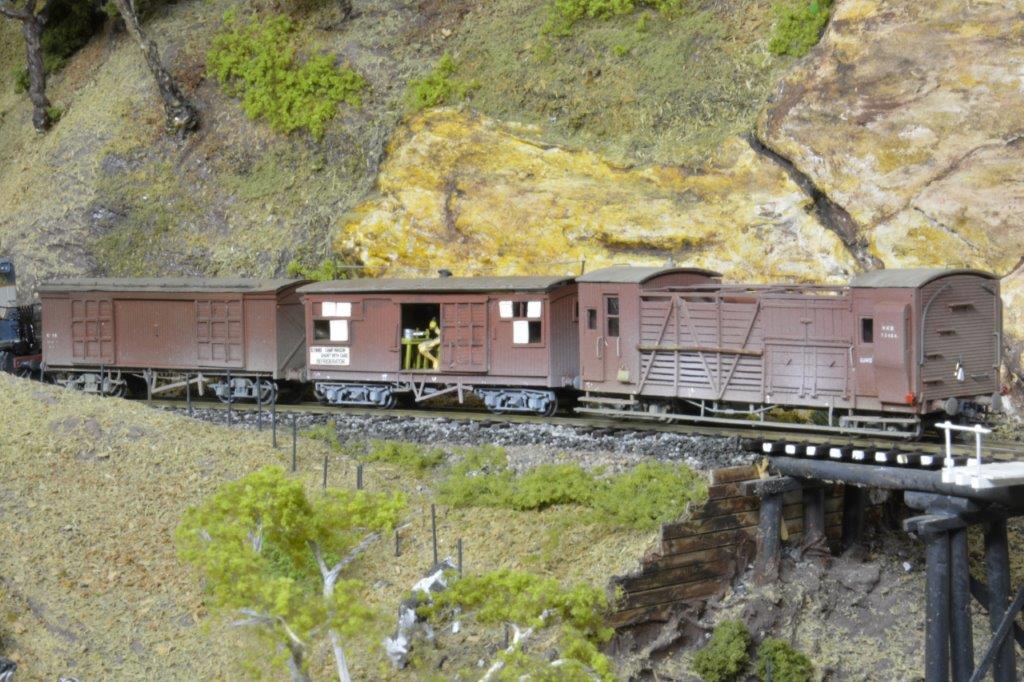
Train 6678 would run
Monday to Friday between Brisbane and Toowoomba. In the early eighties the
State Government had contract freight rates to keep trucks off our roads. Many
Transport Companies had sidings and trains allocated to convey their wagons.
Most were mainly to North Queensland.
Hiles Transport shared a
siding at Countess Street Roma Street, they loaded wagons for Toowoomba and
Dalby. In the late 1980’s Roma Street moved to Acacia Ridge and QR offered
customers door to door freight, parcel traffic carried on passenger trains became
part of this traffic. This move closed all the suburban goods stations around
Brisbane. Rocklea still had the traffic to and from Commonwealth Engineering
and GEC.
Hiles Transport was moved
to Rocklea. The goods shed on the Back Road was moved up near the front gate were
demountable offices were erected. An open steel shed 100 feet by 200 feet was
erected over the Refuse, Middle and Back Roads. A concrete pad were poured from
the front gate to outside the shed on the Brisbane end.
6678 on a Train
Safety Test before departing for Toowoomba. Warwick HWO behind the engine. Empty
hold back wagons (HWO/QLX) in the Middle Road.
At first the freight was
mainly loaded into QLX wagons, 6 HWO’s were allocated to the traffic, 3 for
each day. One was used for Dalby loading and the other two for Toowoomba. One
of the Toowoomba HWO’s carried ruff/cranky freight/loading like bundles of steel.
Three QLX’s on the Brisbane of the Middle Road were allocated to parcels/small
freight, taxi truck type freight. This didn’t work with to many trucks in the
shed after 4:00pm in the afternoon. These wagons were moved to the Salisbury
end of the yard. Three (3) QLXP’s were allowed the traffic, these wagons left
Rocklea early/mid afternoon for the Car Shed Mayne to go on the front of the Dirranbandi
Mail (3H14) Monday and Thursdays. QLXP wagons (red diamond) used on passenger
trains were ultrasonic tested ever three months. You were always cutting out wagons
to be tested at Normanby, and then replacing them with wagons from traffic. The
test date was shown on the roller bearing/axle box on both sides. Wagons out of
date could be used as express freight wagons (red circle).
Late 1980’s the company opened
a depot at Warwick. By this time 14 HWO’s were captive to the traffic, 7 per day
each way. One Dalby, One Warwick, and five (5) for Toowoomba. This did away with
the need to pallet jack freight into the ends of QLX wagon. HWO’s were loaded
by forklifts with loads coming directly off the trucks. At the end of the day
or as wagon were filled, QR traps covered the wagons. At time there was extra
QLX’s and HWO in the yard. If wagons were in short supply, HSA/HWA were used.
1620 shunting
Brisbane end of shed. At times when the loading was heavy, a shunt was required
to reset the loading roads mid-afternoon.
Train 6678 was worked by
Mayne traincrew, a driver and a driver assistance (DA). The train engine
arrived at Rocklea at 7:00 pm. After shunting, train test, it departed Rocklea at
20:30, Laidley 10:04 / 27 for a meal stop, and arrived Toowoomba at 12:54. As
the number suggest it was an Express Freight service conveying red diamond and
circle wagons only. Around 1985 the status of QLX wagons was downgraded to red
circle wagons status. (New requirements for passenger train vehicles, non-
welded wheels. Maybe this was the reason for the end of spoked wheels ?? ). If the
loading was handed over at 19:30 and a few things fell into place, on time
departure was achievable, the train safety test look around 15/20 minutes.
The train came in for
special instruction in the Working Time Table, the 1990 WTT shows the
following.
Marshalling of 6678.
This train must as far as
practicable be restricted to a maximum of 75 units and will convey loading for
stations Toowoomba and beyond to and include Roma, and non-perishable loading
for stations beyond Roma, and also loading for stations south of Toowoomba. It
will also convey contract wagons account Hiles Transport for Toowoomba, Dalby
and Warwick. Any Dalby contract wagons will go forward from Toowoomba not later
than 7D78 (depart Toowoomba 1:40, arrive
Dalby 4:15 am) Tuesday to Fridays and 6R12 (1:55 am) on Saturday. Any Warwick contract wagons will go forward
from Toowoomba on 7E44 (departs Toowoomba
2:15 Tues to Fri. arrive Warwick at 5:55am) (2:30 Sat). The Dalby contracts
and/or parcel wagons will be marshalled at the rear of the train. The Warwick
contract wagons will be marshalled immediately behind the locomotive followed
by the Toowoomba contract wagons. Loading for stations west of Toowoomba is to
be marshalled in reverse order as the train is admitted “Head on” to the
Toowoomba Station Yard. In other words, DEL, Warwick, Toowoomba contract, other
Toowoomba loading, South West loading in reverse order and Dalby on the rear. This
was the last train out of Brisbane each evening with connections to the south
and west.
In mid 1980’s, the
Australian Dangerous Goods Code came into practice. Hiles Transport had the
contract for CIG gas for SWQ. This generally consisted of Classes 2.1, 2.2 and
2.3 gas, some of these should not be on the engine or be the last wagon. Other
classes conveyed included class 3, 6.1 and 8. At one point they had a Shell Oil
contract for lubricants for Roma, Charleville and Quilpie, QLX’s were used for
this traffic. At times we had 1.4 and 5.1. I regularly received a visit or phone
call from the DG Officer the next day. The
company had another contract with Toowoomba Foundry for scrap steel from BHP Acacia
Ridge in half high open containers. This order could very from 1 to 3
containers per day. QFC, PYC and BR wagons were used. Side loader would bring
the containers to the yard and load the wagons.
Scrap steel for
Toowoomba Foundry.
Mostly 90 ton DEL’s were
rostered on the train, 1250, 1450, 1460 and 1502 classes. The through load was
630 tones, the leading wagon must have D1 (auto) drawgear. At times we would
give a 90 DEL 690 tons and arrange for a banker at Murphy Creek. Later 2100
class DEL’s were given 720 tons as a through load. Other times a 90 and a 60 toner
would be allocated to the train. Wagons fitted with D3 and D2 hook drawgear
must be marshalled in the trailing 620 tonnes, thankfully where was no D4 hook
drawgear for the train.
1510 shunting his train
before departure. Not my shift, looks like Warwick on the engine and then Dalby.
Train in the Middle Road.
At the start of a new
month when customers had a 30 day account, contract wagons would make a full train.
Towards the end of the month the contract loading would drop off, top up loading
would be arrange from other stations. Mostly it was empty containers from
Acacia Ridge for Wallangarra, Toowoomba, Oakey or Dalby, often single slot
wagons with hook drawgear (D3) were in the mix. This made a long train, I
recall 90 units one night, the maximum length for a train in this era, and the
Refuse was just 60 units long. Other times it was tanks from Ampol.
At the start, Rocklea had
a staff of 10, Station Master (3rd Class), Two Assistant Station Master 4th class (ASM), 3 Parcels Clerks,
a Checker, and 3 Lad Porters. Shunting of trains fell back onto the ASM and the
train Guard or later the Driver’s Assistance (DA). Lad Porters over 18 years of
age were allowed to shunt and did most of the Commonwealth Engineering work
bring DELS in and out. By 1990 it was two ASM’s and one Porter/Shunter. The
ASM’s would work 5:00 am to 1:00 to set up the yard with wagons from the west.
The other shift was 12:45 pm to 8:45 pm or finish for the afternoon shunts and 6678.
The ASM’s would work out
the forecast load (which change hourly), work out the marshalling, compiled the
Train Wire, rated invoices, train documentation with dangerous goods etc., status
change wagons, rollingstock book entries, shunt and operated signals and fight the
Train Examiners when they would mark off wagons after all the loader had gone
home.
The yard consisted of a
Refuse Siding (approx. 60 units), Middle Road (45 unit), Back Road (32 units), this was a dead end siding with the
stop blocks on the Brisbane end. Ramp Road, a dead end towards Salisbury off
the Back Road, and ComEng straight. If the train was over 60 units the train
was made up in two roads. The rear of the train would be in the refuse, and the
front of the train in the Middle Road. Given the fall of the sidings the train
was made up with the engine on the rear. 60 unit was the maximum length you
could run around on the main line due to signal track circuit’s locations. This
move occurred between passengers trains, lucky for
us the sparky’s crossed at Rocklea. After
running around, the engine would pick up the middle road and run out towards
Brisbane and set back onto the rear of the train in the refuse. Then you would push
the lot back towards Salisbury up the Com-eng straight. The main line was
required for this move. There was a Limit of Shunt board toward Moorooka
limiting the length that could be added in this move. Towards the end of the month some time you
had loading in the Refuse and the Com-eng straight plus the two loading roads.

Middle of the
yard looking towards the city.
The loading sidings were
set up to suit the Contractor, not the requirement for train marshalling, in
fact it was the reverse. Middle Road was all Toowoomba, HWO on the Brisbane end
in the shed and the QLX’s on the Salisbury end, on the train the QLX’s had to lead
(that’s a double shunt). The Back Road had Dalby on the block (rear on the
train), then Warwick (front of the train) and then Toowoomba over flow, Roma and
containers which trailed the Toowoomba HWO’s. At times a wagon planned to be
loaded didn’t get loaded, if Dalby and Warwick loading blow out during the day,
the two wagons would not be together. All in all, every shift was different. I did the train for about 8 years, not two
trains were the same. During this time where was not one derailment or any safe
working breaches recorded on my shift. However, one night I did knocked over
the stop blocks on the Back Road. The driver was playing games setting back
slower than walking pace. They were making a billy of tea, and it was the last
move of the shunt running empties back into the Back Road. We tried to keep the
Middle Road clear for the morning. So I started playing games, oops, the radio
didn’t work and I was out of sight for a light signal, into the stop block they
went. We pulled then back into place the next day with the shunt. My shift was called the “A” team. The other
ASM was Garry Brown, the “B” team, he would say the “Best” Team. I can’t tell
you what he called the “A” Team, I think you can guess. The first night I had a
Traffic Inspector drop in for about one hour and never saw another one.

Acacia Ridge
shunt dropping off a HWO just out of shops. The white door stops and steps look
very nice ?? (As build doors).
Circular Memo 38/92 dated 16/09/92
Wagons allocated as at 11th
September 1992.
Hiles, Rocklea.
HWO 39542, 39543, 39545, 39546, 39547,
39548, 39549, 39550, 39552, 39553, 39554, 39555, 39556, 39557. (During my time,
all wagons were of the original design).
HWO with one
end gate in place. This gives some idea of the loading gauge.
QLX 37004, 37005, 37007,
37009, 37010, 37014, 37015, 37017, 37018, 37019, 37021, 37022, 37023, 37027,
37030, QLXM 37002, 37006, 37008, 37011, 37012, 37013, 37016, 37025, 37026,
37028. (“M” wagons were fitted with a diaphragm type triple with accelerated
release, accelerated release reservoir, slack adjusted, smaller auxiliary
reservoir. This was to reduce incidents of skidded wheels. QLX wagons fitted
with “WF” type triple valves were reclassified QLXW, later to become QLW).Weekly
Notice 33/87 29th April 1987. It is preferred that in all express
freight trains in North Coast Traffic in excess of 109 units in length, that
the last 10 wagons of each train be wagons with “WF” diaphragm triples. Over
time, all QLXP wagons were fitted with “M” brake gear.
In later years, label holders were add
to the sides between the doors for dangerous goods labels, these were larger
than the standard QR label and did not fit on the headstock. On most wagons a red
circle plate was also added above number board. Some Workshops took a few short
cuts when painting, no blackboards or logo, grey headstock/underframe.
First contract
QLX wagons did not have securing bars in the loading area, after 30 years of
service the class was changed to CLX. By this time most QLX securing bars were
laying around good yards not in use. Storage space was provided in the wagon
above the doors. In some cases this reduced the loading area and they were
tossed out. With pallet loading the bars were not used.
One workshop
was adding larger numbers in bright colours.
In 2013, QLX 37010 was back in
Toowoomba. (Store wagon)
The wagon still had its original brake
equipment except the AF Triple valve has been replaced with a WF diaphragm
triple valve.
6678
Wagons on Westgate
HWO Dalby. In later years the Dalby wagon was
fitted with side and end gates. These gates are to the loading gauge outline. This
allowed for double staging of pallet loads, plus long loads could go across the
top. The standard QR tarp was too small to cover the load. Two long traps were
used along the side gates, these were company traps. They were clipped to the
top of the gates and tied off under the doors. Three QR tarps were used for the
roof. Later on the Warwick wagon was also fitted with gates. These wagons
remained captive to their destinations (more shunting??).
Dalby wagon on “Westgate”
HWO Toowoomba HWO’s,
Ruff loading. The load is all loose and can be removed.
The load consists of gas bottles, gates, wire netting, coils of wire, mesh, steel,
star pickets, H beam, wooden crates, 200 lt drums, poly pipe. The various
bundles are separated with dunnage and pallets.
HWO Toowoomba,
Spam ham tins for KR Darling Downs. Ever now and then, the boys managed to bust
open a pallet, tins everywhere. Great for screws in the workshop. ???
HWO Warwick before gates were used as
per the first photo.
Marshalled Train 6678 on "Westgate"
6678 on
“Westgate” with Ampol tanks as top up loading. Load approx..600 tons.
On the lead is
the Warwick HWO and a Warwick overflow QLX.
The QLXP is the
start of the Toowoomba loading.
Toowoomba QLX’s
leading the Toowoomba loading.
Rear of train,
Toowoomba HWO’s, Ampol Tanks (in this location they could be Toowoomba or
Dalby) and on the rear is a Dalby QLX overflow and the Dalby HWO with gates.
QLXP is a
Wuiske Model repainted.
Ampol tanks on
the front for Warwick.
The models are a mix of manufactures;
Hauling Loco DEL 1256 – Black Diamond
Models.
QLX’s - Wuiske Models (RTR)
OLE - (Black) Wuiske Models Kit, OL -
(Silver) Scratch build made into AMRA Mould (1974)
HWO – CGL Models. (RTR). Loads have been
added.
All
up a great location to model, all rollingstock required is now available RTR.
Not all that much track work is required, Main Line, Refuse, Middle Road and a
dead end Back Road, about seven sets of points. If trains were kept to under
the length of the Refuse, only five sets of points are required. A shelf layout
would do it nicely.
Train Wire of train
6857 (Mon 08/02/1993) from the rear showing wagons being returned to
Rocklea. The Dalby and Warwick wagons
are in the correct place for an easy shunt.
49 vehicles
includes containers loaded on wagons, there was 30 wagons on the train and
vehicle DEL 1526. Near a full load and
maximum length for 2415.
There is a lot more I could say about
the shunting of the train. Maybe later??
Trust the information is helpful and
assists you in your modelling.
Until next time, happy modelling.
Arthur Hayes.